


Triple Whale vs LeadJourney — Triple Whale is for ecom. LeadJourney is for lead generation.
Triple Whale dominates Shopify ecom attribution — built for AOV, blended ROAS, cart events, and product-level analytics. If you sell physical products on Shopify, Triple Whale is the right tool. If you generate leads — agencies, coaches, B2B services, financial advisors, course creators — you need a platform built for forms, calls, CRM stages, and closed deals. That's LeadJourney.


LeadJourney vs Triple Whale — Different Audiences, Different Tools
Triple Whale is the leader in Shopify ecom attribution. LeadJourney is the equivalent for lead-gen — different conversion model, different metrics, different tool entirely.
| Features | | Triple Whale |
|---|---|---|
| Lead-gen conversion tracking | Forms, calls, CRM stages, closed deals | Cart, checkout, AOV (ecom only) |
| Shopify ecom integration | Not built for ecom | Native Shopify integration |
| CRM revenue attribution | Closed-deal revenue from CRM | No CRM stage tracking |
| B2B CRM integrations | HubSpot, Pipedrive, Salesforce native | No CRM integrations |
| AI search engine tracking | Native AI search engine tracking | AI agent for ecom only |
| Customer journey model | Click → form → call → deal timeline | Click → cart → checkout (ecom) |
| Server-side accuracy | Server-side via first-party domain | Server-side via Shopify integration |
| Multi-touch attribution | Multi-touch out of the box | Multi-touch (ecom-focused) |
| EU data hosting | Frankfurt, Germany — EU residency | US-hosted |
| AI marketing analyst | Atlas — lead-gen-focused AI analyst | Moby — ecom-focused AI agent |
Why Lead Gen Teams Don't Use Triple Whale
Form Submission Tracking
Track form submissions across Wix, Webflow, WordPress, custom builds — with full source attribution from Meta, Google, AI engines, organic, and more
Call Tracking & Attribution
Track inbound calls with click-to-call attribution — see which ad clicks drove which phone leads, including duration and qualification
CRM Stage Attribution
Connect HubSpot, Pipedrive, Salesforce, or any CRM via webhook — see CRM stages from MQL to closed deal mapped to original ad clicks
Closed-Deal Revenue Sync
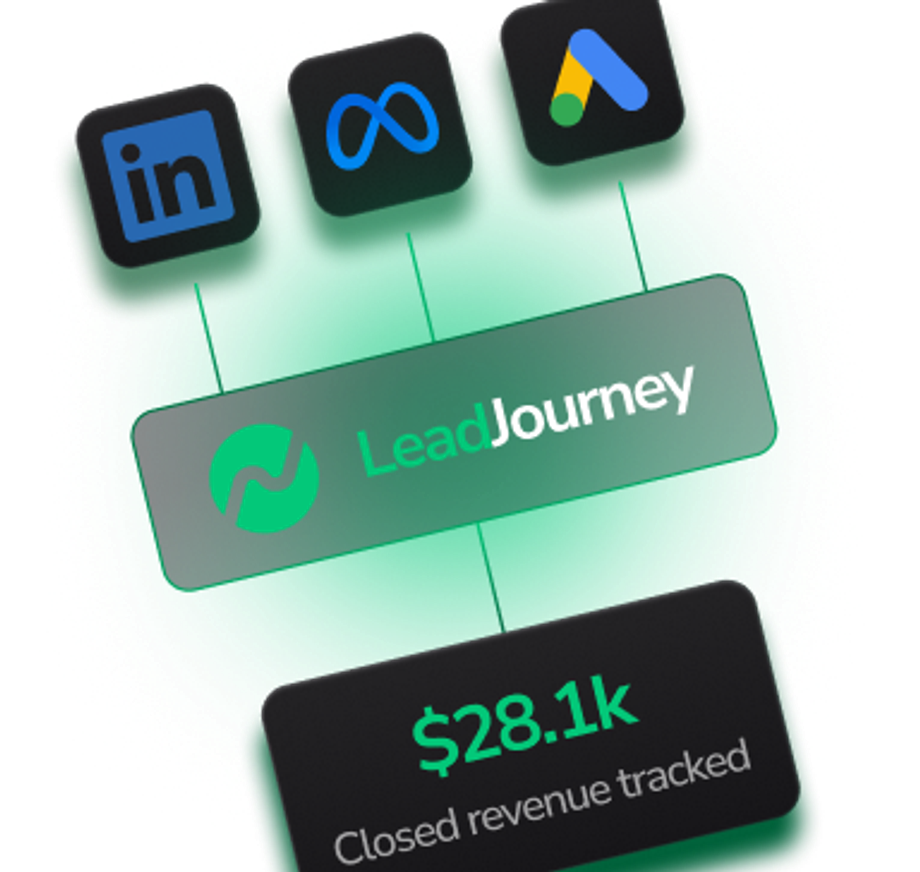
Closed-deal revenue flows back to Meta, Google, LinkedIn & Bing — algorithms optimize for actual buyers, not form fillers
Service & Subscription Friendly
Track service offers, consulting bookings, demo requests, pipeline value — not just one-time product purchases
Triple Whale vs LeadJourney —
Your Questions Answered
Get answers to commonly asked questions.
Didn’t find the answer you were looking for?
Our team is here to help! Reach out to us and we’ll be happy to answer any questions about LeadJourney.
Triple Whale is built for Shopify ecommerce — it tracks AOV, blended ROAS, product-level performance, cart events, and checkout completion. The whole conversion model assumes 'click to add-to-cart to checkout to purchase.' Lead generation businesses don't have carts — they have forms, calls, CRM stages, and deals that close days or months after the click. LeadJourney's conversion model is purpose-built for that: click → form → call → qualified lead → closed deal. If you don't sell products on Shopify, Triple Whale's metrics aren't designed for you.
You can install Triple Whale's tracking, but it won't measure anything useful for lead-gen. Form submissions, call leads, CRM stages, and closed-deal revenue aren't part of Triple Whale's core data model — the dashboards, the AI agent (Moby), and the reports are all built around ecom transactions. You'd be paying for ecom features and getting incomplete lead-gen tracking. Most agencies and B2B teams who try this realize within a few weeks that they need a lead-gen-specific tool.
Yes — some businesses run both. If your company sells physical products on Shopify AND has a B2B services arm, you'd use Triple Whale for the Shopify side and LeadJourney for the lead-gen side. They don't conflict because they're tracking different conversion types. Most pure lead-gen businesses just use LeadJourney.
LeadJourney has native integrations with HubSpot, Pipedrive, Salesforce, and any CRM via webhook (Zapier, Make, n8n). CRM stage data flows into LeadJourney automatically — every MQL, SQL, Opportunity, and Won deal is mapped back to the original ad click. Triple Whale doesn't integrate with B2B CRMs at all because ecom doesn't have a CRM pipeline.
Yes — distinct AI search tracking is built in. Claude, ChatGPT, Perplexity, Copilot, DeepSeek, Gemini, and Grok all show up as separate sources, with full attribution to forms, calls, and closed deals. This is especially important for B2B and high-consideration purchases where buyers do AI-driven research before becoming a lead.
Triple Whale's AI agent (Moby) is built around ecom data — it answers questions about AOV, product performance, repeat purchase rate, and cart abandonment. LeadJourney's Atlas is built around lead-gen data — it answers questions about cost per qualified lead, pipeline value by source, closed-deal revenue by campaign, and AI search engine ROI. Same idea, different audience.
Lead Gen Needs Different Tools.
LeadJourney Was Built For Yours.
Forms, calls, CRM stages, closed deals — the lead-gen attribution platform. Built for agencies, coaches, B2B services, and consultants.

LeadJourney is the only tool we found that connects every ad campaign to real revenue in our CRM. Setup was fast, the team is responsive, and our reporting actually makes sense now — even our sales team uses it.
