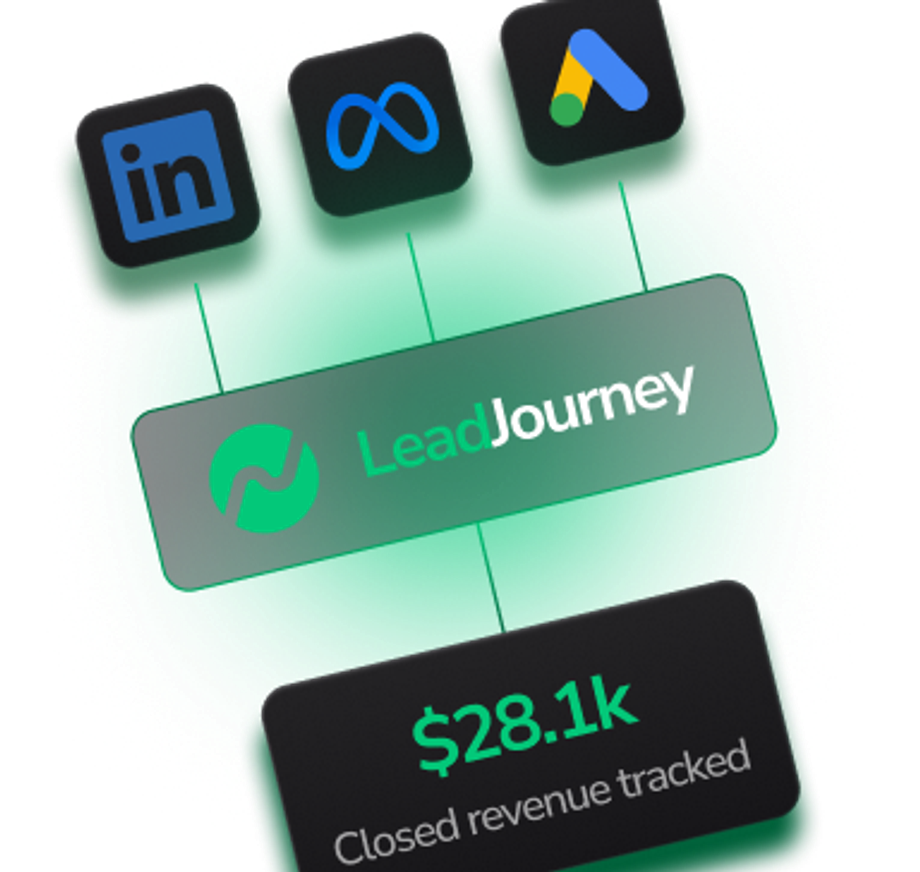
Cost per lead (CPL) is a marketing metric that measures how much a business spends on advertising to acquire a single lead. It is calculated by dividing total ad spend by the number of leads generated in the same period. Despite being one of the most reported numbers in performance marketing, CPL is also one of the most misunderstood — because the version most platforms display is almost never the version that actually matters.
The CPL number reported by Meta or Google counts form submissions. The CPL number that determines whether a campaign is profitable counts closed deals. The gap between those two numbers is where most lead generation budgets quietly bleed money.
How to Calculate Cost Per Lead
The basic formula is simple: CPL = total ad spend ÷ total leads generated. If you spent €10,000 last month and generated 200 leads, your reported CPL is €50. The trick is defining 'lead' correctly — and recognising that a form fill is not a customer.
The Three Versions of CPL Worth Tracking
- Cost per qualified lead: ad spend divided by leads that passed your team's qualification criteria. Excludes spam, no-shows and obvious mismatches.
- Cost per booked call: ad spend divided by leads who actually scheduled a meeting. The first reliable indicator of campaign quality.
- Cost per closed deal: ad spend divided by leads that became paying customers. The only number that determines whether a campaign is profitable.
See your true cost per closed deal, not just per form fill
Connect your CRM and see real CPL — qualified, booked, closed.
Why Reported CPL Is Almost Always Wrong
Three things distort the CPL ad platforms report. First, form fills include unqualified leads, no-shows and ghosters — none of whom are customers. Second, iOS privacy, ad blockers and cookie consent strip 30-40% of pixel events, so your real CPL is often lower than reported. Third, lead quality is invisible: two campaigns can have identical CPLs while one closes 30% of leads and the other closes 3%. Without CRM-matched data, you cannot tell them apart.
What's a Good Cost Per Lead?
There is no universal answer — a good CPL depends entirely on customer lifetime value (CLV) and close rate. For high-ticket B2B services with €10,000+ deal sizes, a €200 CPL can be excellent. For low-ticket consumer offers, the same €200 CPL would be ruinous. The right benchmark is 'cost per closed deal as a percentage of deal value' — typically 10-30% is healthy depending on the business model.
How to Reduce Cost Per Lead
- Improve targeting using closed-deal data sent back to ad platforms via CAPI and Enhanced Conversions.
- Capture full conversion data with server-side tracking to fix iOS and consent loss.
- Optimise creative around the audiences that actually close — not the ones that just fill forms.
- Move spend toward channels with the lowest cost per closed deal, not the lowest reported CPL.
Conclusion
Cost per lead is a useful number — but only if you measure it correctly. Optimising for reported CPL leads to scaling cheap form fillers; optimising for true cost per closed deal leads to scaling actual revenue. The difference comes down to whether your tracking connects ad spend to CRM outcomes, and whether you trust form fills or closed deals as the definition of a 'lead'.